

Table of Contents
- What to Look for in the Best Back Stretcher for Home Use
- Types of Back Stretchers: Lumbar, Hanging, and More
- How Long to Use a Back Stretcher for Best Results
- Back Stretcher Exercises at Home: A Simple Routine
- Back Stretcher Safety: What to Know Before You Start
- Comparing Back Stretchers: Key Features and Trade-Offs
- Frequently Asked Questions
Last Updated: October 21, 2026
What to Look for in the Best Back Stretcher for Home Use
Finding the best back stretcher for home use comes down to three things: a contoured shape that follows your spine, adjustable intensity so you can start gently, and a build that stays stable on the floor. This guide from Nuksy walks through the features that matter, the types available, and how to use one safely.

Stability and adjustability decide whether the device earns a permanent spot in your routine or ends up behind the couch.
Design and Build Quality
A back stretching device should feel planted the moment you lie on it. Look for a wide base, a non-slip underside, and a curved profile that supports the lumbar region without digging in. Cushioned contact points matter too: a memory foam pad or textured surface spreads pressure instead of concentrating it on one spot.
Check the materials. Durable construction means the arch holds its shape under repeated use rather than flexing or cracking. Compact storage is a bonus for smaller homes, but never trade stability for a smaller footprint.
Adjustability and Comfort Features
Adjustable levels are the single most useful feature for beginners. Multi-level adjustment lets you set a low arch for the first week and increase stretch intensity gradually as your flexibility improves. A fixed, aggressive curve is fine for experienced users and miserable for everyone else.
Comfort details worth prioritizing:
- Multiple arch heights or removable inserts
- Raised massage points for a massage-like sensation during stretching
- A cushioned support surface along the spine
- Ergonomic design that follows the natural curve of the back
Types of Back Stretchers: Lumbar, Hanging, and More
Device type shapes how you use a back stretcher, how much space it needs, and where it fits in your day. The four families below cover nearly every home option, and each has a distinct use case and a distinct limitation.
Passive Arch Boards and Lumbar Stretchers
A passive arch board is the most common home option. You lie down on a curved surface that supports the lower back and gently extends the spine.
The limitation is that the stretch is entirely gravity- and body-weight-driven. You control intensity by arch height and by how much weight you rest on the device, not by pulling or hanging. That makes arch boards the easiest type to use consistently, but also the least aggressive form of decompression.
Chair and Seat Lumbar Supports
A chair-compatible lumbar support sits against an office chair or car seat and adds spinal support during long stretches of desk work or driving. These are the most portable option and the only type that works while you are upright and productive. The trade-off is arch height: a seat-back support cannot deliver the same extension as a floor device, so it complements rather than replaces a floor stretcher.
Traction-Style Devices
Traction devices use straps, a frame, or a harness to apply a controlled pull along the spine rather than a passive arch. They tend to be bulkier, require more setup, and demand more attention to positioning. For most homes, a floor-based arch board offers more consistent use with far less fuss, but traction-style devices appeal to users who want a more directed stretch.
Hanging Back Stretchers
A hanging back stretcher suspends you from a frame so gravity decompresses the spine. These take up more room, require a sturdy door or frame, and demand more upper-body control to get in and out safely. They are the least forgiving type for beginners and the hardest to store in a small home.
Matching Type to Use Case
| Type | Best for | Setup | Main limitation |
|---|---|---|---|
| Passive arch board | Daily floor stretching at home | None | Gravity-driven only |
| Chair/seat support | Desk work and driving | None | Limited arch height |
| Traction device | Directed pull along the spine | Moderate | Bulkier, more positioning |
| Hanging stretcher | Gravity decompression | High | Space and upper-body strength |
For most households, a compact, adjustable floor model covers the widest range of needs. A contoured stretcher with textured massage points and multiple color options fits that brief: non-electric, easy to keep at home, and suited to both lower back and neck use. Shoppers who want a single device for stretching and sitting support will find the Nuksy Back Stretcher & Lumbar Support Massager covers both roles.
How Long to Use a Back Stretcher for Best Results
Start with two to three minutes per session and build slowly. Most people work up to five to ten minutes once daily, and consistency matters far more than duration. Longer sessions do not speed progress and can leave muscles sore.
A practical progression:
- Week one: 2 minutes at the lowest arch setting
- Week two: 3 to 5 minutes, still low
- Week three onward: 5 to 10 minutes, adding height only when the current level feels easy
Stop if you feel sharp pain, numbness, or tingling. Discomfort from a new stretch is normal; pain is a signal to back off.
Back Stretcher & Lumbar Support Massager →
Back Stretcher Exercises at Home: A Simple Routine
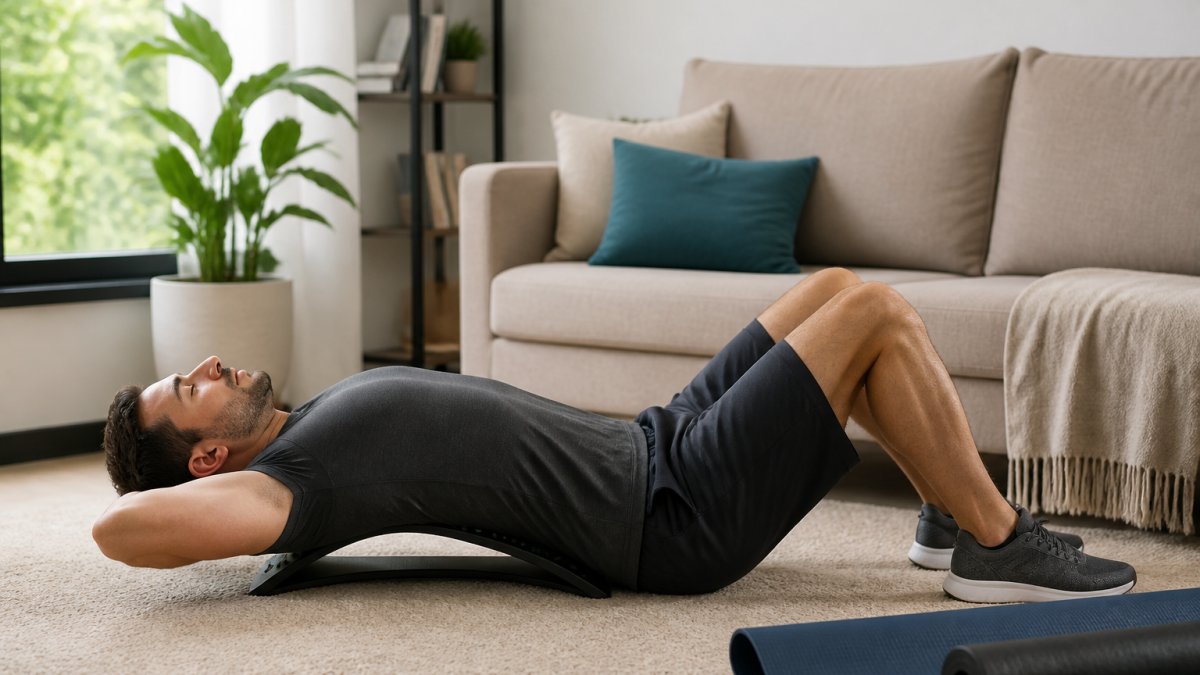
Back stretcher exercises at home work best as a short, repeatable routine rather than an occasional long session. Ten minutes, done most days, beats an hour once a month.
Getting Started Safely
Begin on a flat, non-slip surface. Place the stretcher where your lower back will rest on the arch, then lower yourself down slowly, supporting your weight with your hands. Keep your knees bent and feet flat to protect the lower back.
Sample 10-Minute Routine
- Minute 1-2: Lie on the lowest arch setting, knees bent, breathing slowly.
- Minute 3-4: Gentle pelvic tilts while the back rests on the arch.
- Minute 5-6: Knee-to-chest holds, one leg at a time.
- Minute 7-8: Slow torso rotations, keeping hips square.
- Minute 9-10: Lie still and let the back settle before standing.
Roll to your side and push up with your arms when you finish. Standing straight up from a stretched position is a common mistake that jolts the lumbar region.
Back Stretcher Safety: What to Know Before You Start
Back stretcher safety starts with knowing your own limits. These devices are designed for general stretching and relaxation, not for treating an injury, and they are not a substitute for diagnosis or treatment. Anyone with an existing back condition, recent surgery, osteoporosis, a spinal fracture, or ongoing pain should check with a healthcare professional before use.
Who Should Consult a Clinician First
It is often recommended to check in with a healthcare professional before starting any spinal stretching device if you fall into one of these groups:
- You have a diagnosed back condition, disc issue, or spinal fracture
- You have had back or spinal surgery in the past year
- You have osteoporosis or another condition that affects bone strength
- You are pregnant
- You have numbness, tingling, or weakness in the legs
- You are unsure whether a stretch is safe for your body
This is not a complete list, and it is not medical advice. When in doubt, ask before you stretch.
Warning Signs to Stop
Discomfort from a new stretch is normal; pain is a signal to back off. Stop using the device and speak with a healthcare professional if you notice:
- Sharp or shooting pain during or after a session
- Numbness, tingling, or weakness in the legs or feet
- Dizziness or nausea
- Pain that worsens over successive sessions rather than easing
Fit Guidance for Different Bodies
Fit matters as much as technique. Before buying, compare the device's dimensions and weight capacity against your own body and floor space. A stretcher that is too short for your torso will not support the lumbar region where it needs to, and one rated below your weight may flex or feel unstable. If you have limited mobility or balance concerns, choose a floor model you can lower yourself onto with hand support, and keep a stable chair nearby for getting up.
Other Precautions Worth Following
- Never force the stretch or bounce on the arch
- Keep sessions short and stop at the first sign of sharp pain
- Avoid using a stretcher on a soft bed or uneven surface
- Roll to your side and push up with your arms when you finish
- Store it out of the way so it doesn't become a trip hazard
Comparing Back Stretchers: Key Features and Trade-Offs
Choosing between options means weighing adjustability, footprint, and how you plan to use the device. The table below summarizes the trade-offs across common configurations.
| Feature | Why It Matters | Trade-Off |
|---|---|---|
| Adjustable levels | Lets beginners start gently | More parts to set up |
| Fixed arch | Simple, nothing to adjust | Harsh for new users |
| Cushioned pad | Spreads pressure comfortably | Can wear over time |
| Compact design | Easy to store at home | May feel less stable |
| Chair-compatible | Doubles as lumbar support | Less arch height |
| Hanging frame | Gravity-based decompression | Needs space and strength |
For most households, a compact, adjustable floor model covers the widest range of needs. A Nuksy-style contoured stretcher with textured massage points and multiple color options fits that brief: non-electric, easy to keep at home, and suited to both lower back and neck use. Shoppers who want a single device for stretching and sitting support will find the Nuksy Back Stretcher & Lumbar Support Massager covers both roles.
Before buying, confirm the basics: dimensions that fit your floor space and a weight capacity you're comfortable with. Customer reviews are useful for spotting stability complaints, but treat them as one input among several.
Frequently Asked Questions
How long should you use a back stretcher?
Start with short sessions of 1 to 3 minutes and gradually work up to 5 to 10 minutes as your back adjusts. The key is consistency rather than duration. If you feel discomfort, stop and try again later. Many people find a brief daily session after work or exercise helpful for relaxation. Always listen to your body and avoid pushing through pain. For specific guidance, consult a healthcare professional.
Are back stretchers suitable for everyday use?
Many people use back stretchers daily as part of a gentle stretching routine. However, it's important to start slowly and pay attention to how your body responds. If you experience soreness or discomfort, reduce frequency or duration. A back stretcher like the Nuksy Back Stretcher & Lumbar Support Massager is designed for everyday home use, but you should always check with a doctor if you have existing back issues or concerns.
What should you look for in a back stretcher for home use?
Focus on adjustability, comfort, and build quality. Look for multiple stretch levels to match your flexibility, a cushioned surface for comfort, and a stable base. Portability is a plus if you plan to move it between rooms. The Nuksy Back Stretcher & Lumbar Support Massager offers contoured support and textured massage points at $44.87, making it a practical option for home stretching.
What is the difference between a back stretcher and a massage device?
A back stretcher is designed to support the spine and promote flexibility through gentle stretching, often using an arched shape. A massage device focuses on manipulating soft tissue with vibration or rollers. Some products, like the Nuksy Back Stretcher & Lumbar Support Massager, combine both features with textured massage points on a contoured surface. The choice depends on whether you prioritize stretching or muscle relaxation.
Building a back care routine is easier when the tools are simple, affordable, and ready to use at home. Nuksy stocks practical wellness finds like the Back Stretcher & Lumbar Support Massager, backed by free U.S. shipping on every order, easy returns, and secure checkout. Add one to your daily routine and give your back ten minutes of relief.