

Last Updated: November 1, 2026
Quick Summary
The best countertop utensil organizers for rental kitchens are freestanding, divided holders that need no drilling or adhesive and lift away clean at move-out. Look for a non-slip base, at least three compartments, drainage holes, and a removable top section for easy cleaning and packing.
- Measure the free counter strip and cabinet clearance before buying any holder.
- Three divided sections cover the daily load: knives, cooking tools, and serving spoons.
- Stainless steel survives moves best, while ceramic and porcelain chip or crack in transit.
- Drainage holes in the base stop water pooling under washed utensils.
- Keep only daily utensils in the holder and store the rest to save counter space.
Table of Contents
- What Makes a Countertop Utensil Organizer Rental-Friendly?
- No Drilling, No Adhesive, No Damage
- Surface-Safe Bases and Stable Weight
- Countertop Utensil Storage: Capacity, Footprint, and Compartments
- Small Kitchen Organization: Making Every Inch of Counter Count
- Materials Compared: Ceramic, Stoneware, Metal, Bamboo, and Acrylic
- Renter-Friendly Kitchen Organization: Cleaning, Moving, and Lease Rules
- Common Buying Mistakes to Avoid
- Picking Your Rental Kitchen Utensil Holder
- Frequently Asked Questions
What Makes a Countertop Utensil Organizer Rental-Friendly?
Rental-friendly countertop utensil organizers are freestanding holders that need no drilling, no adhesive, and no permanent change to the kitchen. It sits on the counter, holds cooking utensils upright, and lifts away clean when the lease ends.
That definition matters more than most buying guides admit. Renters lose deposits over small things: screw holes in cabinet doors, adhesive residue that pulls paint, water rings on laminate. The best countertop utensil organizers for rental kitchens solve a storage problem without creating a landlord problem. This guide from Nuksy walks through the criteria that actually matter for renters, from base stability to lease terms, so the purchase holds up in a unit someone else owns.
Here's the throughline: in a rental, portability and surface protection beat capacity and style every time. A big ceramic crock that holds everything is worthless if it chips the countertop or cracks during the next move.
No Drilling, No Adhesive, No Damage
Damage-free installation is the first filter. Any organizer that mounts to a wall, hangs under a cabinet, or sticks to a backsplash is out.
Freestanding designs ask nothing of the building. A holder with a weighted base and a non-slip pad stays put during daily use and lifts off in seconds. Compare that to adhesive strips, which often leave residue or peel paint when removed, a common source of move-out deductions. If you need to close gaps around a sink or counter without drilling, this waterproof sink seal tape offers a renter-safe sealing option.
Surface-Safe Bases and Stable Weight
Stability comes down to two things: base width and weight distribution. A narrow, tall holder tips when a spatula is pulled at an angle. A wide, low one stays planted.
Look for these traits:
- A non-slip base or rubber feet that grip without scratching
- Enough heft that the holder does not slide when reaching for a utensil
- Rounded or padded contact points instead of sharp metal edges
- A low center of gravity, meaning heavy utensils sit near the bottom
In practice, the heaviest item in the holder sets the tipping risk. Knives and ladles should sit in the deepest compartment, not the shallow front slot.
Countertop Utensil Storage: Capacity, Footprint, and Compartments
Countertop utensil storage is a trade-off between how much a holder carries and how much counter it eats. Renters usually have less of both to spare, and unlike a homeowner, they cannot solve a space problem by adding a drawer or a wall rack.
Start with the counter strip, not the holder. Measure the free counter beside the stove before buying. A workable method: clear the counter, then measure the depth from the backsplash to the front edge and the width of the strip you are willing to give up. A holder that blocks the only prep zone becomes a nuisance within a week, and in a small rental there is often no second zone to fall back on. Note the clearance under upper cabinets too, a tall holder that will not slide under the cabinet line is a return waiting to happen.
Capacity is about usable depth, not total volume. A wide, shallow crock holds a lot of spoons but tips knives. A tall, narrow cylinder holds long utensils but hides short ones at the bottom. The practical target for a rental is a holder deep enough for the longest utensil you own (tongs and ladles are usually the outliers) and wide enough that a hand can reach the bottom without emptying the whole thing.
Compartments do the organizing. Divided sections keep spoons, spatulas, and knives in separate lanes so the holder stays sorted without a jumble. For most rentals, three sections cover the daily load: one for knives, one for cooking tools, one for serving spoons. More than that starts to shrink each lane until long utensils no longer fit.
A practical setup for a rental counter:
| Rental Need | What to Look For | Why It Matters |
|---|---|---|
| Tight counter | Tall, narrow footprint | Frees prep space |
| Mixed utensils | 3+ divided sections | Stops clutter and tangling |
| Washed utensils | Drainage holes in base | Prevents pooled water |
| Frequent moves | Removable top section | Packs flat, cleans easily |
| Shared kitchen | Freestanding design | No installation disputes |
The Nuksy stainless steel knife and utensil organizer is a freestanding countertop organizer with three divided compartments, a removable top section, and bottom drainage holes, so no installation is required.

Small Kitchen Organization: Making Every Inch of Counter Count
Small kitchen organization starts with vertical storage. Utensils stored upright take a fraction of the counter space they would take lying in a drawer or sprawled beside the stove.
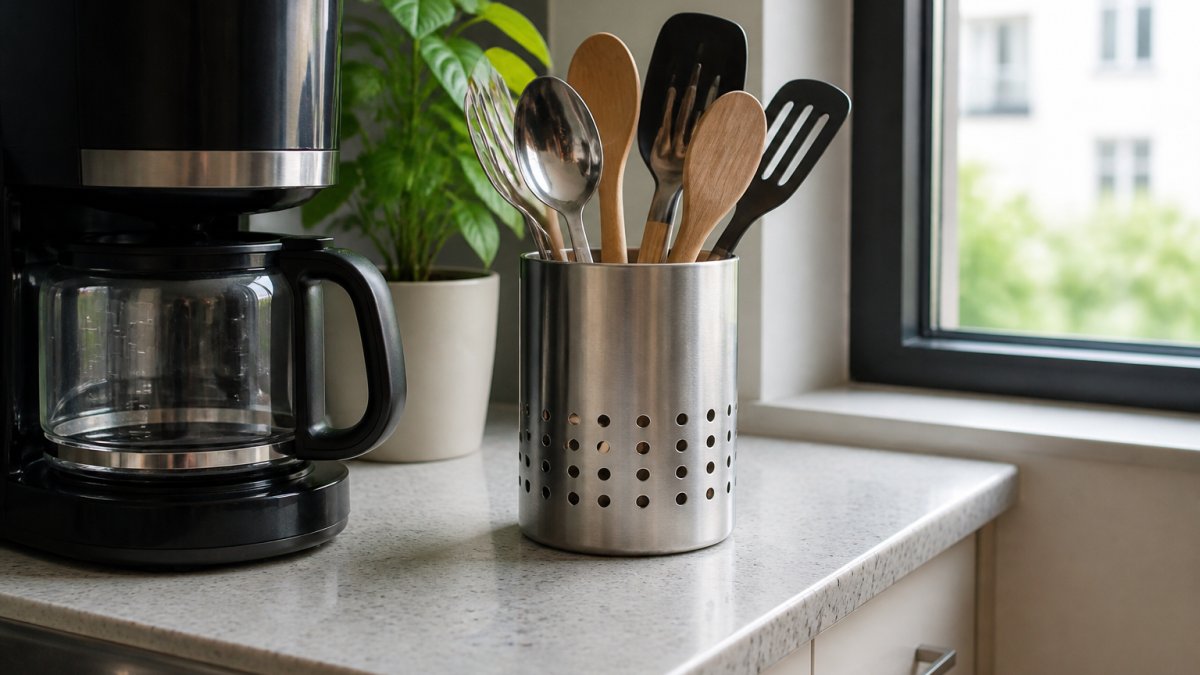
Three habits keep a small counter clear:
- Keep only daily utensils in the holder and store the rest.
- Push the holder into a corner or against the backsplash.
- Choose a holder with a wide opening so utensils go in one-handed.
Materials Compared: Ceramic, Stoneware, Metal, Bamboo, and Acrylic
Material decides four things a renter lives with daily: how stable the holder feels, how easy it is to clean, how it survives a move, and whether it can mark the counter. Each option has a clear best case, and a clear failure mode.
Ceramic and stoneware. Heavy, which is exactly why they feel stable: the mass sits low and resists tipping when a spatula is pulled at an angle. The trade-off is fragility. Glazed ceramic chips at the rim, and stoneware cracks under the shock of a move if it is packed without padding.
Metal, especially stainless steel. The trade-off is that thin metal can dent and that bare metal edges need rounded or padded contact points so they do not scratch laminate or quartz.
Stainless Steel Knife & Utensil Organizer – Countertop Holder →
Bamboo. Warm-looking and lightweight, and often the most affordable option. The failure mode is moisture: bamboo warps and can split if utensils go back in wet or if the holder sits in a puddle. It needs air circulation and occasional drying. A bamboo holder suits a dry, well-ventilated counter but is the riskiest choice next to a sink.
Acrylic. Shatter-resistant and inexpensive, which makes it a common first-apartment pick. It scratches, though, and scratched acrylic shows wear quickly, especially when knives and metal utensils rub the sides. It also tends to look cloudy over time. Acrylic is fine for spoons and spatulas but a poor match for a holder that will carry knives.
Porcelain. Similar to ceramic with a finer, glossier finish and often a higher price. The same fragility applies: it chips at thin rims and cracks in transit. Treat porcelain as a stay-put option, not a mover.
A quick comparison for rental use:
| Material | Stability | Move Survival | Cleaning | Best For |
|---|---|---|---|---|
| Ceramic / stoneware | High (heavy) | Low (chips, cracks) | Hand wash | Stable, styled counters |
| Stainless steel | Medium (needs non-slip base) | High | Wipe or rinse | Renters who move often |
| Bamboo | Medium | Medium (warps if wet) | Hand wash, dry fully | Dry, ventilated counters |
| Acrylic | Low (light) | High (shatter-resistant) | Wipe | Spoons and spatulas only |
| Porcelain | High | Low | Hand wash | Stay-put, styled kitchens |
The Nuksy stainless steel knife and utensil organizer is made of stainless steel and plastic and has a removable top section.
Renter-Friendly Kitchen Organization: Cleaning, Moving, and Lease Rules
Renter-friendly kitchen organization has to survive three events: weekly cleaning, the move-out inspection, and the move itself.
On cleaning, choose a holder that wipes clean or goes in the dishwasher if the material allows. Removable sections make the job faster, and drainage holes stop water pooling under washed utensils.
On lease rules, check the agreement before adding anything that attaches to a surface. Freestanding holders sidestep the question entirely.
On moving, empty the holder, wrap breakable materials, and pack utensils separately. For more damage-free ideas across the whole home, see these renter friendly home organization ideas. Lightweight metal or acrylic holders travel better than stoneware.
Common Buying Mistakes to Avoid
The most common mistake is buying for looks before measuring the counter. A stylish oversized crock that crowds the stove gets moved to a closet within a month.
Other frequent errors:
- Choosing a tall, narrow holder that tips when a utensil is pulled
- Skipping drainage, which leaves water sitting in the base
- Buying ceramic for a household that moves often
- Assuming a holder will fit under upper cabinets without checking clearance
- Ignoring the lease before installing anything permanent
What most guides miss is the move-out angle. A holder that scratches the counter or leaves residue can cost more in deductions than it saved in convenience.
Picking Your Rental Kitchen Utensil Holder
The right pick comes down to a short checklist: freestanding, stable, divided, drainable, and portable.
Run through it before buying:
- Does it stand on its own with no drilling or adhesive?
- Is the base wide enough to resist tipping?
- Are there at least three compartments for knives, spoons, and spatulas?
- Does the bottom have drainage holes?
- Can the top section be removed for cleaning and packing?
- Does the footprint fit the available counter strip?
- Is the material light enough to move without cracking?
The Nuksy stainless steel organizer is freestanding, divided, drainable, and has a removable top section.
Renting should not mean living with cluttered counters or risking a deposit over storage. Nuksy stocks practical home and kitchen finds, backed by free U.S. shipping on eligible orders, easy returns, and secure checkout. Browse the stainless steel knife and utensil organizer and the rest of the home and kitchen range, then set up a counter that works today and packs up clean tomorrow.
Frequently Asked Questions
What is the best way to store cooking utensils on a countertop?
Group utensils by how often you use them and keep the everyday ones in a freestanding holder within arm's reach of the stove. A divided organizer with separate sections keeps knives, spoons, and chopsticks organized, and a removable top section lets you access the holder more easily. Look for drainage holes at the bottom so washed utensils can drain.
Are utensil crocks a good choice for small kitchens?
They can be, as long as you pick the right size. A crock uses vertical space instead of drawer space, which helps in small kitchen organization when drawers are already full. Measure your free counter run first and choose a holder with a narrow footprint. A freestanding model you can lift and move is more flexible than a built-in or mounted option, especially if you rearrange your kitchen often.
How do you organize a rental kitchen without making permanent changes?
Stick to freestanding, portable pieces that need no drilling or adhesive. A countertop utensil organizer like the Nuksy Stainless Steel Knife & Utensil Organizer ($21.90) sits on the counter, has three divided compartments, and lifts away when you move out. Check that any base is smooth and non-slip so it won't scratch countertops, and keep the original packaging so packing is quick at the end of your lease.
What should I look for in a countertop utensil organizer?
Focus on four things: capacity that matches your utensil count, a footprint that fits your free counter space, a stable base, and easy cleaning. Materials matter too; stainless steel and plastic are the materials used in the Nuksy organizer. Drainage holes and a removable top section are practical features to look for.
