

Table of Contents
- Start With a Repeatable Online Product Quality Checklist
- How to Evaluate Product Reviews Without Getting Fooled
- How to Compare Product Specifications Across Listings
- Inspect Product Photos and Descriptions for Real Quality Signals
- Questions to Ask an Online Seller Before You Order
- Check Seller Legitimacy, Return Policy, and Buyer Protection
- What to Do When You Can't Verify Quality Before Delivery
- Conclusion
- Frequently Asked Questions
Last Updated: October 17, 2026
Start With a Repeatable Online Product Quality Checklist
Learning how to verify online store product quality comes down to one habit: checking the same evidence in the same order every time.
Here is the core idea. Quality signals live in the details shoppers skip: the spec sheet, the zoomed photo, the seller's answer to a hard question.
Run these checks before you order:
- Reviews: read the middle ratings, not the five-star ones
- Specs: confirm materials, dimensions, and weight in writing
- Photos: zoom in on seams, edges, and hardware
- Seller: ask two or three pointed questions
The Federal Trade Commission's shopping guidance is a useful starting point for knowing your rights as a buyer.
How to Evaluate Product Reviews Without Getting Fooled
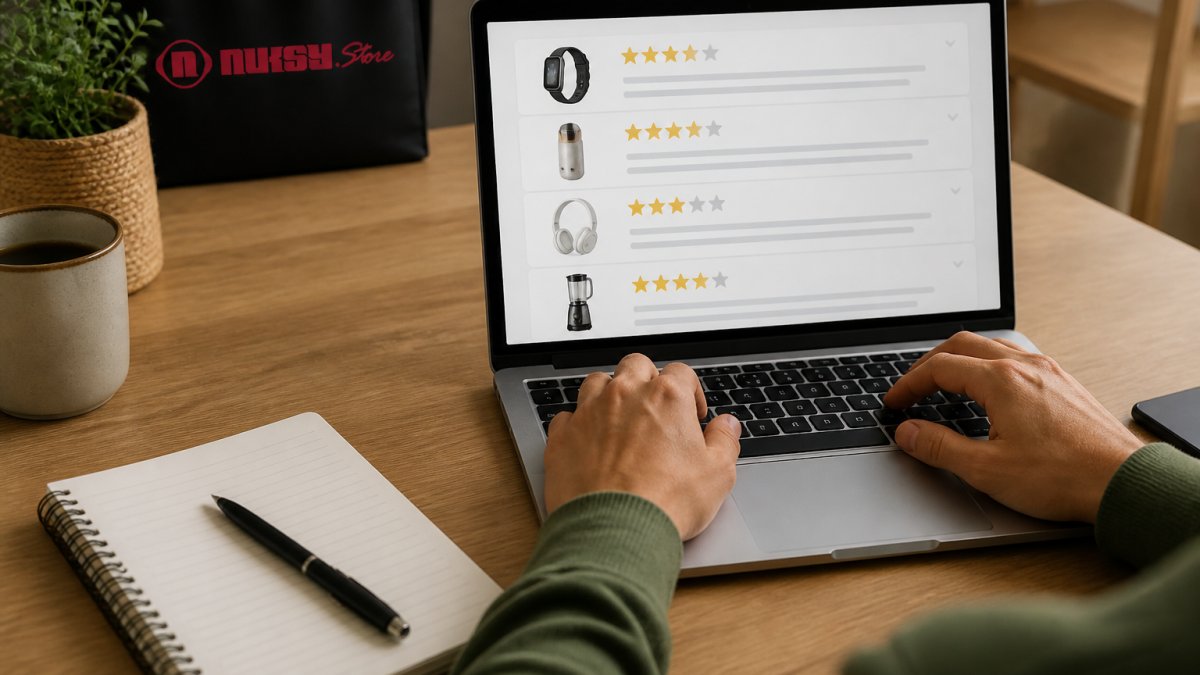
Product reviews are the fastest quality signal and the easiest one to fake. The goal is not to find perfect reviews. It is to find reviews that sound like they came from real people with real complaints.
Spot Fake and Unreliable Reviews
Fake reviews tend to share a fingerprint. They are short, glowing, and vague. They praise the seller as much as the product. They cluster in a tight window of dates.
Watch for these warning signs:
- A burst of five-star reviews posted within a few days
- Reviews that mention shipping speed but never the product itself
- Identical phrasing across multiple reviews, sometimes with one word swapped
- Reviewers with a single review on their profile
The FTC's rule on fake reviews and testimonials bans the sale or purchase of fake reviews and makes it illegal to misrepresent them. That rule exists because the problem is common.
Read for Balance, Not Just Star Ratings
A product with a 4.2 rating and 300 reviews is usually a safer bet than a product with a perfect 5.0 and 12 reviews. The first has been stress-tested.
Read the two- and three-star reviews first. Those writers cared enough to complain but were not angry enough to exaggerate. They tend to describe the exact flaw you will hit.
How to Compare Product Specifications Across Listings
Comparing product specifications is where careful shoppers separate themselves. Two listings can look identical in photos and differ completely in the spec sheet.
Line up the same fields side by side:
| Spec Field | What to Check | Why It Matters |
|---|---|---|
| Materials | Named material, not "premium blend" | Predicts how it wears over time |
| Dimensions | Exact measurements with units | Prevents a size surprise |
| Weight | Stated weight for the item and package | Signals build and shipping cost |
| Construction | Stitching, joints, hardware, coating | Shows where corners were cut |
| Care | Washing, cleaning, or storage instructions | Reveals fragile finishes |
| Warranty | Length and what it covers | Shows seller confidence |
A listing that names its materials is a listing that expects scrutiny. Vague terms like "high quality" or "durable construction" tell you nothing. If a spec is missing, that omission is a data point.
Inspect Product Photos and Descriptions for Real Quality Signals
Product photos do two jobs: they show you the item, and they show you how much the seller is hiding. Zoom in.
Look for these quality indicators in the images:
- Stitching: even, tight lines with no loose threads or skipped stitches
- Edges and hems: clean, curved hems and finished seams, not raw cuts
- Hardware: zippers, clasps, and screws that look solid, not thin or painted
- Texture: fabric quality and surface finish visible under light
A seller who photographs the inside, the base, and the close-up of a seam is proud of the build.
Read the product description the same way. The Consumer Product Safety Commission publishes recall notices worth checking for any product category you buy often.
Questions to Ask an Online Seller Before You Order
Asking a seller two or three direct questions does more than any review. It tests whether the seller knows the product and how they handle buyers. The trick is not just asking, it is reading the answer for specificity, consistency, and willingness to be pinned down.
Send these before you buy:
- What material is the main body made of, and what is the finish?
- What are the exact dimensions and weight, including the package?
- What does the return window cover, and who pays return shipping?
- Is this item in stock and ready to ship, or is it a preorder?
- Can you send a photo of the actual item, not the stock image?
- Which part of this product is most likely to wear out first, and why?
That last question is the tell. A seller who knows the product will name a specific component, a hinge, a coating, a seam, a battery door, and explain the trade-off.
How to Read the Answer
Score each reply on three things:
- Specificity: Does the answer name materials, measurements, or components, or does it repeat the listing?
- Consistency: Does the answer match the spec sheet and photos? A mismatch is a red flag.
- Willingness: Did they offer to send a real photo, check with a supplier, or confirm a detail, or did they dodge?
A fast, specific answer is a good sign. A vague answer, a copy-paste of the listing, or silence tells you how support will feel after the sale. This is one place where a store's customer support reputation gets tested before you spend a dollar.
Category-Specific Questions Worth Adding
The same six questions work across categories, but a few extras sharpen the read:
- Home and kitchen: Ask whether the item is dishwasher-safe, what the interior coating is, and whether replacement parts are sold separately.
- Smart tech and accessories: Ask which standards the device supports, what is in the box, and whether firmware updates are provided after purchase.
- Fitness and wellness: Ask the exact weight capacity, what material contacts the body, and how the item is cleaned.
- Pet essentials: Ask whether the materials are chew-resistant and how the item is sanitized.
At Nuksy, product pages are built to answer these questions up front, and the support team responds to pre-purchase questions directly.
Check Seller Legitimacy, Return Policy, and Buyer Protection
Seller legitimacy is the quiet foundation of every other check. A perfect product from a store that vanishes is still a loss. Most guides stop at "look for an address and a return policy." The stronger move is to verify claims against independent evidence rather than trusting the listing's own words.
Verify the Store Itself
Check these before you spend:
- A real business address and contact method, not just a form
- A return policy written in plain language, with a stated window
- A refund policy that says who pays return shipping
- Secure checkout with a recognizable payment processor
Then go one step further: cross-check the seller's claims against sources the seller does not control. Search the business name alongside terms like "complaint," "refund," and the state where it is registered. Check whether the same product photos appear on unrelated sites, a common sign of a drop-shipper reusing manufacturer images. If the store claims a certification, look up the certifying body and confirm the claim independently rather than accepting a badge image.
Read the Return and Refund Policy Line by Line
Look for restocking fees, exclusions, and the difference between "return" and "exchange." A generous policy is a signal of confidence. A policy full of traps is a warning. Pay attention to:
- The exact window, counted from delivery or from order date
- Whether opened items are eligible
- Who pays return shipping and whether a label is provided
- Whether refunds are issued to the original payment method or as store credit
- Any category exclusions (often personal-care, intimate, or opened-electronics items)
Use Reversible Payment and Document Everything
Pay with a credit card or another method that lets you dispute a charge. The FTC's guidance on disputing charges explains how to challenge a charge that does not match what you received. Keep the order confirmation, the product page, and the return policy as saved files.
When Quality Cannot Be Verified Before Delivery
Sometimes the evidence runs out. The product is new, the reviews are thin, and no one has answered your questions. That is not a dead end, but it does change the math. Use a scoring framework to weigh quality against risk:
| Factor | Low Risk | High Risk |
|---|---|---|
| Review count | 100+ with a mix of ratings | Under 20, all five-star |
| Spec detail | Named materials and dimensions | Vague or missing |
| Return policy | Clear window, easy terms | Restocking fees or short window |
| Seller contact | Direct answers, real address | No response, form only |
| Payment | Reversible method | Untraceable method |
If two or more factors land in the high-risk column, treat the purchase as a test. Buy one item, not three.
When quality cannot be confirmed in advance, buyer protection becomes the product. Choose the seller whose policy protects you if the item disappoints.
Nuksy keeps this simple with free U.S. shipping on every order, easy returns, and secure payments, so a first order carries less risk.
What to Do When You Can't Verify Quality Before Delivery
Sometimes the evidence runs out. The product is new, the reviews are thin, and no one has answered your questions.
Use a scoring framework to weigh quality against risk:
| Factor | Low Risk | High Risk |
|---|---|---|
| Review count | 100+ with a mix of ratings | Under 20, all five-star |
| Spec detail | Named materials and dimensions | Vague or missing |
| Return policy | Clear window, easy terms | Restocking fees or short window |
| Seller contact | Direct answers, real address | No response, form only |
| Payment | Reversible method | Untraceable method |
If two or more factors land in the high-risk column, treat the purchase as a test. Buy one item, not three.
When quality cannot be confirmed in advance, buyer protection becomes the product.
Nuksy keeps this simple with free U.S. shipping on every order, easy returns, and secure payments, so a first order carries less risk.
Conclusion
The hardest part of online shopping is not finding products. It is trusting them before they arrive. A repeatable checklist, honest review reading, and a clear-eyed look at the return policy close most of that gap.
Nuksy is built for shoppers who want that confidence without the guesswork. Every order ships free within the U.S., returns are easy, checkout is secure, and support answers real questions before you buy.
Frequently Asked Questions
How can you tell if an online product is good quality?
Look for specific, verifiable details rather than vague praise. Check that the product description lists materials, dimensions, and construction methods. Read balanced reviews that mention both pros and cons. Inspect product photos for clarity and zoom capability. Confirm the seller has a clear return policy and responsive support. A repeatable online product quality checklist helps you compare listings objectively instead of relying on star ratings alone.
Are customer reviews a reliable way to judge product quality?
Reviews can be useful, but only when you evaluate them carefully. Look for reviews that describe specific use cases, mention durability over time, and include photos. Be wary of listings with only five-star ratings, generic praise, or reviews posted in bursts. Cross-check reviews across multiple platforms and prioritize balanced feedback. For a more reliable signal, combine review analysis with specification comparisons and seller questions.
What should you check in an online store's return policy?
Confirm the return window, who pays return shipping, and whether refunds are issued to the original payment method. Look for restocking fees and exclusions for opened items. A straightforward return policy is a strong quality indicator because it reduces your risk. If the policy is hard to find or full of conditions, treat that as a warning sign and ask the seller directly before ordering.
How can you compare similar products online?
Build a simple comparison table with columns for materials, dimensions, weight, warranty, and return terms. Pull specifications from each product description and verify them against independent reviews where possible. Note which features matter most for your use case, then score each option. This approach helps you compare product specifications objectively and avoid choosing based on marketing language alone.