

Table of Contents
- Why a Latex Lumbar Pillow Holds Its Shape
- Latex Lumbar Pillow Types: Talalay vs Dunlop and Molded vs Shredded
- Choosing Loft, Firmness, and Profile by Sleep Position and Body Size
- A Latex Pillow for Office Chair Support
- Latex vs Memory Foam Lumbar Pillow: Which Fits Your Chair
- How to Clean a Latex Pillow Without Damaging the Core
- Using a Lumbar Pillow for Car Seats and Long Drives
- Pricing, Certifications, and Deciding If Latex Is Right for You
- Frequently Asked Questions
Last Updated: October 14, 2026
Why a Latex Lumbar Pillow Holds Its Shape
A latex lumbar pillow is a support cushion filled with latex foam, made from rubber tree sap and known for its resilience and bounce-back.
Latex foam is naturally resilient and ventilated, so air moves through it instead of building up heat the way dense foams can. That structure is why a latex cushion feels supportive rather than soft and squishy.
Latex Lumbar Pillow Types: Talalay vs Dunlop and Molded vs Shredded
Latex cushions fall into two material camps, Talalay and Dunlop, and two construction styles, molded and shredded. Each combination changes how the pillow feels and how long it lasts.
| Type | Feel | Best For | Notes |
|---|---|---|---|
| Talalay latex | Softer, more uniform | Those who want gentle support | Airier cell structure |
| Dunlop latex | Firmer, denser | Firmer lower-back support | Feels more solid |
| Molded latex | Consistent, one piece | Everyday chair use | Holds shape well |
| Shredded latex | Adjustable loft | Sleepers who want to customize | Can be added or removed |
Talalay vs Dunlop: What the Process Changes
Talalay latex is vacuumed into a mold and flash-frozen, producing a lighter, more uniform cell structure. Dunlop latex uses a simpler pouring process, so the foam settles denser at the bottom and feels firmer. For a lumbar cushion, the choice comes down to preference: Talalay for a softer, springier feel, Dunlop for firmer support.
Molded vs Shredded Fill
Molded latex is poured as a single piece, so the pillow holds one consistent shape and firmness. Shredded latex is torn foam packed into a cover, letting users add or remove fill to adjust profile height. A common mistake is buying shredded fill without checking for a zipper, since an unzippable cover means the loft cannot be adjusted.
Choosing Loft, Firmness, and Profile by Sleep Position and Body Size
What determines whether a latex lumbar pillow works is the gap it fills, the distance between your lower back and whatever surface is behind you, and that gap changes with sleep position, body size, and the seat or mattress you are on. Here is how to estimate that gap and match it to a profile height and firmness level.
Start With the Gap, Not the Pillow
The most useful measurement is the space your lower back leaves in your normal position. You can estimate it without tools:
- Sitting in a chair: Slide your flat hand behind your lower back. If your hand fits with room to spare, you have a large gap and need a thicker profile. If your hand barely fits or your back is already touching the chair, you need a thin profile or none at all.
- Lying on your side: The gap is roughly the distance from your waist to the mattress, which tracks closely with shoulder width. Broader shoulders mean a taller pillow.
- Lying on your back: The gap is usually small, often less than the width of two fingers, which is why back sleepers rarely need a thick lumbar roll.
Matching Profile Height to Position and Frame
Use these ranges as starting points, then adjust. They describe the pillow's compressed height once your body weight is against it, not the height out of the box.
| Position | Typical gap | Starting profile | Firmness to start with |
|---|---|---|---|
| Side sleeping | Large (shoulder-width) | Tall | Medium-firm to firm |
| Back sleeping | Small | Low to medium | Medium |
| Stomach sleeping | Minimal | Lowest available | Soft to medium |
| Seated (office, car) | Moderate | Medium | Medium-firm |
Body size shifts these ranges. Taller frames and broader shoulders generally need more loft and firmer support because the gap they create is larger. Smaller frames often find a medium-firm cushion in a medium profile already fills the space, and going thicker pushes the spine forward.
Why Firmness and Height Are Not the Same Choice
A common mistake is treating firmness and loft as one decision. They are separate:
- A tall, soft pillow collapses under weight and fills less space than its height suggests.
- A short, firm pillow holds its shape but may not reach the gap at all.
- A tall, firm pillow fills a large gap but can feel like a wedge against the spine if the gap is actually small.
Pick the profile height that matches your gap first, then choose the firmness that feels supportive without pressure. If you are between two heights, the shorter one is usually safer, a pillow slightly too thin is easier to live with than one too thick.
Adjusting After You Buy
Latex holds its shape, so it does not "break in" the way some foams do. The fit you feel in the first week is close to the fit you will have in the first year. If it is wrong, adjust the setup rather than waiting:
- Change the seat's recline angle or your mattress position before blaming the pillow.
- Add or remove a cover to fine-tune thickness by a small amount.
- For shredded-fill pillows, remove or add fill to change loft without changing firmness.
A Latex Pillow for Office Chair Support
A latex pillow for office chair support works best when it sits in the natural curve of the lower back, roughly at belt height, rather than at the mid-back.
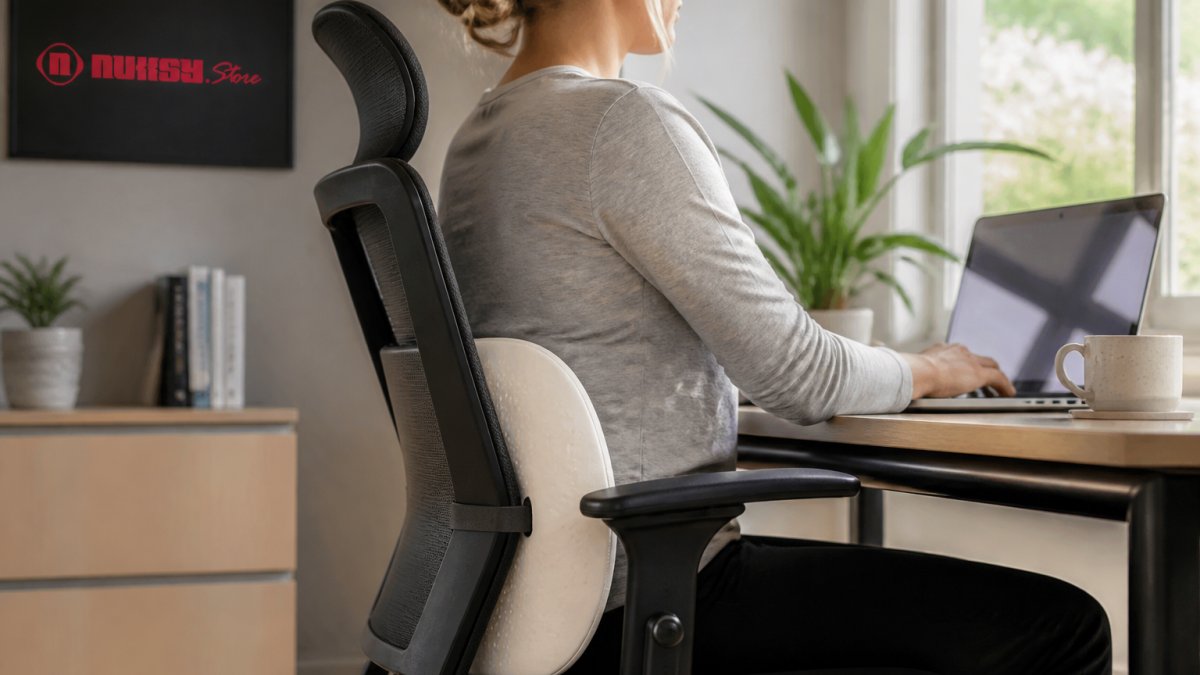
For anyone who wants to combine support with a stretch break, the Nuksy Back Stretcher & Lumbar Support Massager is a non-electric option designed for lower-back and neck use at home, with a contoured shape and raised massage points for stretching and relaxation routines.

Latex vs Memory Foam Lumbar Pillow: Which Fits Your Chair
The latex vs memory foam lumbar pillow comparison comes down to responsiveness. Memory foam softens with body heat and slowly molds to the shape pressing into it, which some find comfortable and others find hot and slow to recover (What is Memory Foam?).
| Factor | Latex | Memory Foam |
|---|---|---|
| Response | Immediate bounce-back | Slow, heat-reactive |
| Temperature | Breathable, cooler | Tends to retain heat |
| Durability | Holds shape long-term | Can soften over time |
| Feel | Springy, firm | Soft, contouring |
For a chair used eight hours a day, latex tends to hold up better. For occasional use where a soft, sinking feel is preferred, memory foam can work fine. Nuksy carries a Memory Foam Seat Cushion for Office Chairs with a shaped center opening and a removable, washable cover.

How to Clean a Latex Pillow Without Damaging the Core
Cleaning a latex pillow starts with the cover, not the core. Most latex cushions have a removable, zippered cover that can be machine washed on a gentle cycle and air dried, while the latex insert should never go in a washing machine or dryer.
Memory Foam Seat Cushion for Office Chairs – Removable Washable Cover →
A few care habits keep a latex cushion in good condition:
- Wash the cover regularly, following the care tag instructions
- Spot clean the core only, never submerge it
- Air dry completely before putting the cover back on
A common mistake is tossing the whole pillow into the wash after a spill. That single cycle can cause the latex to crumble, and the cushion will never hold its shape the same way again.
Using a Lumbar Pillow for Car Seats and Long Drives
A lumbar pillow for car seats helps most when it sits low, at the base of the spine, and stays put through turns and braking. Car seats often have a deeper curve than office chairs, so a thinner profile frequently works better.
For long drives, the same rules apply as at a desk: take short breaks, shift position regularly, and treat the pillow as one part of a comfortable setup rather than a fix for everything.
Pricing, Certifications, and Deciding If Latex Is Right for You
Latex costs more upfront than basic foam, and the honest question is whether that premium pays off for how you actually use the pillow. This section covers value over time, how to read material claims, and when latex is the wrong choice.
Value Over Time, Not Sticker Price
The useful comparison is not "latex versus foam" at checkout, it is cost per year of usable support. A few factors drive that:
- Shape retention: Latex rebounds after pressure is released, so it tends to hold its profile far longer than foams that gradually soften and compress. A pillow that keeps its shape for several years can cost less per year than a cheaper one replaced repeatedly.
- Cover quality: A removable, washable cover protects the core and extends usable life. A non-removable cover means the whole pillow gets dirtier faster and is harder to refresh.
- Fill type: Shredded-fill pillows let you replace or top up fill, which can extend life further than a single molded piece.
When comparing options, ask what the pillow is expected to do, how often it will be used, and whether the cover can be cleaned. Those three answers usually settle the value question faster than any price tag.
Reading Material Claims Without Getting Misled
Labels like "natural," "organic," and "hypoallergenic" are marketing terms as much as material descriptions, and they are not interchangeable. A few practical habits help:
- Read the material description, not the headline. "Natural latex" and "latex foam" can describe very different blends. Look for what the core is actually made of.
- Treat certifications as one input, not a verdict. Third-party testing labels can confirm specific claims, but they do not cover every property a shopper cares about. Check what a given label actually verifies before treating it as a blanket endorsement.
- Check the FTC's guidance on environmental marketing claims for how terms like "natural" and "eco-friendly" are regulated in advertising. The U.S. Federal Trade Commission guidance on environmental marketing claims explains the standards advertisers are expected to meet.
When Latex Is the Wrong Choice
Latex is not for everyone, and being clear about that helps you decide faster:
- You want a very soft, sinking feel. Latex pushes back immediately; it does not contour the way memory foam does.
- You want to machine wash the whole pillow. Latex cores should not go in a washer or dryer, so a pillow you can toss in the machine is a different product category.
- You have a latex sensitivity. The material itself is the issue, regardless of how it is labeled.
A Quick Decision Checklist
Before buying, run through these:
- Does the profile height match the gap your body leaves in your normal position?
- Is the firmness right for how you sit or sleep, not just what sounds supportive?
- Is the cover removable and washable?
- Does the material description tell you what the core is actually made of?
- Does the expected lifespan justify the upfront cost for how often you will use it?
If most answers are yes, latex is likely a good fit. If several are no, a different material may serve you better.
Frequently Asked Questions
What should you look for in a latex lumbar pillow?
Check four things: the latex type (Talalay is softer and more ventilated, Dunlop is denser), the loft or profile height, the firmness, and whether the cover is removable. A removable, washable cotton or mesh cover matters because the latex core itself should not go in a washing machine. Also confirm the pillow fits your chair's lower-back curve rather than just looking the right size on a product page.
Is a latex lumbar pillow suitable for office chairs?
Yes, and the shape often matters more than the material. Look for a contoured profile that fills the gap between your lower back and the chair, with a strap or non-slip backing if your chair has a smooth surface. Latex holds its shape through a full workday better than loose fill, so you are not re-fluffing it after lunch. Pair it with a supportive seat cushion if you sit for long stretches.
How do you clean a latex lumbar pillow?
Spot-clean the latex core with a damp cloth and mild soap, then air-dry it away from direct sun and heat. Never machine-wash or tumble-dry latex. If the pillow has a zippered cover, remove and wash that according to its care tag, which is where most of the day-to-day cleaning happens. Rotate the pillow occasionally so one side does not compress faster than the other.
Can a latex lumbar pillow be used in a car?
It can, though fit matters more in a car than in an office chair. Look for a compact profile that does not push you forward out of the seat, and check that it stays put against leather or vinyl. A smaller size usually works better for drivers because a deep pillow changes your distance from the pedals. Test it on a short drive before committing to a long trip.
Finding the right lower-back support comes down to matching the material and profile to how and where you sit. Nuksy stocks practical comfort picks like the Back Stretcher & Lumbar Support Massager and the Memory Foam Seat Cushion for Office Chairs, both designed for everyday home and office use. Shop Nuksy for free U.S. shipping, easy returns, and secure checkout, and build a seating setup that actually fits your day.