

Table of Contents
- What to Look for in a Pet Hair Vacuum for Small Apartments
- Best Cordless Vacuum for Pet Hair: Runtime and Reach
- Best Stick Vacuum for Pet Hair: Lightweight and Easy to Store
- Vacuum for Pet Hair and Hardwood Floors: What Works Best
- How to Remove Pet Hair from Carpet in a Small Space
- Noise, Maintenance, and Total Cost of Ownership
- Conclusion
- Frequently Asked Questions
Last Updated: October 18, 2026
What to Look for in a Pet Hair Vacuum for Small Apartments
Choosing the best pet hair vacuum for small apartments comes down to one trade-off: you need real pickup power in a machine that disappears into a closet. This guide from Nuksy breaks down the specs that matter when floor space is tight and a shedding dog or cat shares the room. Most apartment shoppers focus on suction alone. Storage, noise, and hair wrap decide whether the vacuum actually gets used.
Storage and Footprint
Measure your closet before you shop. A stick vacuum with a wall bracket frees floor space that an upright eats up. Cordless models that stand on their own can park in a corner between cleanings. Canister vacuums clean well but their hose and body take up more room than most apartment closets allow.

Suction, Brush Roll, and Filtration
Suction pulls loose hair off hard floors; a powered brush roll lifts hair that has worked into carpet fibers. Look for a brush roll you can remove and clean, because hair wraps around it fast in a pet household. A sealed filter traps allergens instead of blowing them back into a small room, which matters more in a studio than in a large house.
Best Cordless Vacuum for Pet Hair: Runtime and Reach
Runtime is the spec that decides whether a cordless vacuum actually finishes an apartment in one charge. The number on the box is almost always measured with the powered floor head off and the vacuum in its lowest mode. In real use, brush roll spinning, wand extended, carpet setting engaged, you get less. So when you compare models, look for the runtime figure that specifies the powered floor head, not the bare-tool maximum.
Map runtime to your floor plan before you buy. A studio or one-bedroom with a mix of hard floors and one area rug typically takes 15 to 25 minutes for a full pass at a normal pace. A two-bedroom with carpet in both rooms and a hallway can push past 30 minutes once you slow down over the high-traffic zones where pet hair collects. If your cleaning session runs longer than the vacuum's powered-head runtime, you will finish on a second charge or switch to a corded backup, neither of which you want in a small space.
Charging time matters as much as runtime. A vacuum that runs 20 minutes and recharges in three to four hours works for a once-a-day pass but not for a mid-week touch-up after a shedding episode. Check whether the battery is removable: a spare battery you can swap in doubles your usable time without buying a second machine, and it stores in the same closet footprint. Wall-mounted charging docks keep the vacuum off the floor and topped up between uses, which suits apartment storage better than a loose charger you have to plug in each time.
Reach is the other half of the cordless equation. A wand that extends lets you clean ceiling corners, the tops of cabinets, and under the bed without a step stool, useful when a small apartment has limited floor space and hair drifts into every gap. A crevice tool handles the seam between couch cushions and the frame, and a dusting brush covers baseboards and window sills where tufts settle.
A practical check before you commit: time your own cleaning routine. Walk your apartment with a stopwatch and note how long each room takes at a normal pace, then add a few minutes for the couch and stairs. If the total lands under the vacuum's powered-head runtime with a comfortable margin, one charge covers your apartment. If it lands close to or over that number, prioritize a model with a removable battery or a longer rated runtime.
Best Stick Vacuum for Pet Hair: Lightweight and Easy to Store
A stick vacuum earns its place in a small apartment when it is light enough to grab one-handed. Weight matters on stairs and when you lift the wand to clean a sofa. Look for a model under about 4 kilograms if you plan to carry it between rooms, and check that the dustbin empties without a fight.
Storage is where stick models win. Many stand upright on their own or hang from a wall bracket, so they take up a sliver of closet space instead of a shelf. The Nuksy cordless stick vacuum is built around this idea: a self-standing design, a wall bracket for storage, and a washable filter that cuts down on replacement costs. It runs on two suction modes and handles hard floors, carpets, furniture, and stairs with the included attachments.
Vacuum for Pet Hair and Hardwood Floors: What Works Best
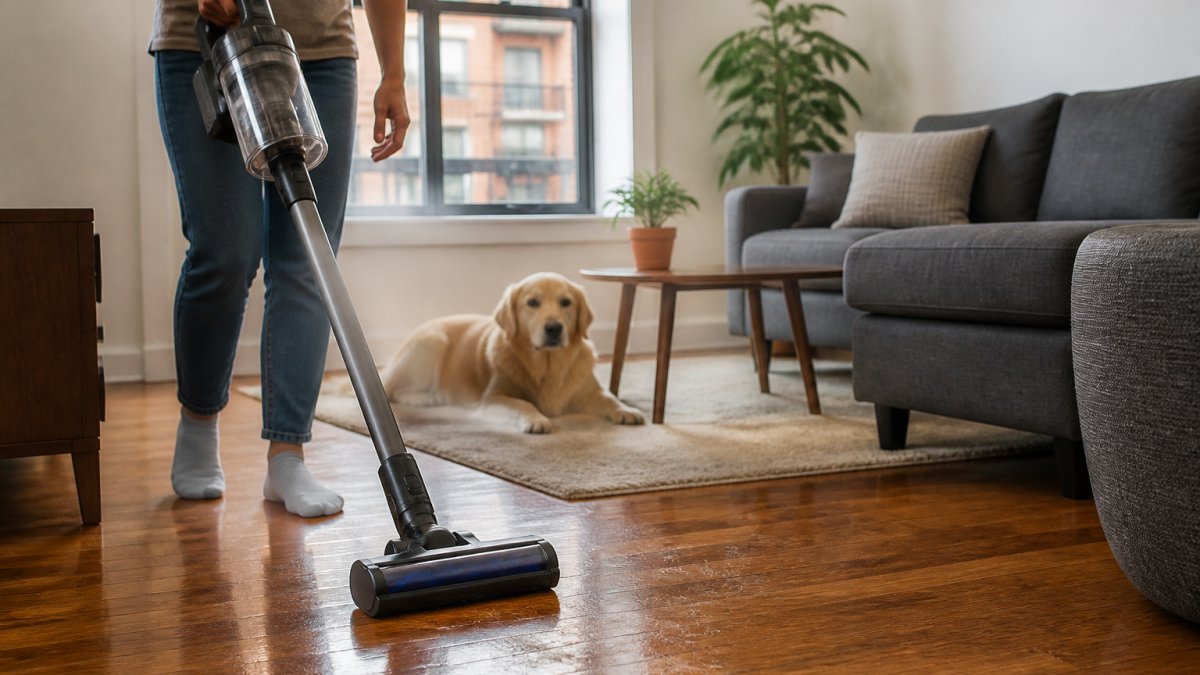
A vacuum for pet hair and hardwood floors works best with strong suction and a soft or adjustable brush, not a stiff bristle roll that scatters debris. On bare floors, hair slides loose and a wide floor head picks it up in one pass. The risk is blowing tufts into corners, so a low setting with good airflow beats brute force.
25KPa Cordless Stick Vacuum for Pet Hair & Floors →
Hard floors make up most of a small apartment, so this is where your vacuum earns its keep. Run the floor head slowly and overlap each pass. Hair that clings near baseboards needs the crevice tool, and a quick pass under the couch catches the tumbleweeds before they migrate. For rugs and mats, switch to the powered head so the brush lifts hair out of the pile.
How to Remove Pet Hair from Carpet in a Small Space
Removing pet hair from carpet takes two passes: one to loosen the hair and one to lift it. Start with a dry pass on high suction to pull surface hair. Then go back slowly with the brush roll so the bristles dig hair out of the pile. A second slow pass in the opposite direction catches what the first one missed.
In a small apartment, carpet usually means an area rug or a bedroom. Vacuum both sides of a small rug when you can, since hair works through the backing. For embedded hair, a rubber squeegee or a damp rubber glove pulled across the pile gathers strands into a clump you can pick up. Follow with the vacuum. Wash or replace the filter regularly, because a clogged filter cuts suction and leaves hair behind.
Noise, Maintenance, and Total Cost of Ownership
Noise is the spec apartment dwellers forget until a neighbor complains. In a shared building, a vacuum runs a few feet from a shared wall, and the sound carries through floors and hallways. Cordless stick vacuums generally run quieter than full uprights because they use smaller motors and less airflow, which helps in close quarters. If you clean early in the morning or late at night, look for a model with a lower-speed mode you can use on hard floors, the reduced airflow is usually noticeably quieter than the high setting, and on bare floors it still picks up loose hair. A machine you avoid running because it is too loud is a machine that lets hair pile up.
Maintenance is where cheap vacuums cost more over time, and in a small apartment the maintenance burden matters more because the vacuum lives close to where you do. Plan a simple cadence:
- Empty the dustbin after every full pass. A small bin fills fast in a pet household, and a full bin cuts suction. Emptying over a trash bag outdoors or into a sealed bag limits the dust puff that recirculates in a small room.
- Check the brush roll weekly. Long human hair and pet hair wrap around the roll quickly. A removable brush roll lets you cut the wrap away with scissors before it strains the motor. If the roll is not removable, cleaning it is a fight, check before you buy.
- Rinse or replace the filter on the schedule the manufacturer lists. A washable filter saves money on replacements, but it still needs regular rinsing and full drying before it goes back in. A clogged filter cuts suction and leaves hair behind, which is the opposite of what you bought the vacuum for.
- Inspect the seals and hose connections. A loose seal leaks suction and lets fine dust back into the room, which matters more in a compact space with limited ventilation.
Add up the filter replacements, belts, and batteries over a few years, and a slightly higher upfront price often wins. A washable filter and a removable brush roll are the two features that most reduce ongoing cost and maintenance time. The Nuksy handheld vacuum covers the quick jobs, couches, stairs, and car seats, so the stick model handles floors while the handheld tackles spot cleaning. Together they cover a small apartment without a single full-size upright, and each one stores in a closet or on a wall bracket.

| What to Check | Why It Matters in a Small Apartment | What to Look For |
|---|---|---|
| Storage footprint | Closet space is limited | Self-standing or wall bracket |
| Runtime | One cleaning pass per charge | Powered-head runtime that covers your floor plan |
| Brush roll | Hair wraps fast with pets | Removable and cleanable |
| Filtration | Allergens recirculate in small rooms | Sealed filter |
| Weight | Carrying between rooms and stairs | Light enough for one hand |
| Filter type | Replacement costs add up | Washable and reusable |
| Noise | Shared walls and close neighbors | Lower-speed mode for hard floors |
Conclusion
Keeping a shedding pet and a clean apartment at the same time is a real challenge, and the right vacuum makes the difference between a quick daily pass and a losing battle. Nuksy carries practical cleaning tools built for exactly this, including a cordless stick vacuum with 25KPa suction, two cleaning modes, and a washable filter, plus a compact handheld vacuum for stairs, sofas, and car seats. Both ship free within the U.S., with easy returns and secure checkout if a model is not the right fit. Get started with Nuksy and put a vacuum that fits your space to work on pet hair today.
Frequently Asked Questions
What type of vacuum is best for pet hair in a small apartment?
A cordless stick vacuum is often the best fit for a small apartment. It is lightweight, stores easily, and handles both hard floors and area rugs. Look for a powered floor head, a brush roll, and a washable filter. If you have stairs or upholstery, a handheld vacuum is a useful add-on. Match the vacuum to your floor types and shedding level rather than buying the largest model.
Are cordless vacuums good for picking up pet hair?
Yes, many cordless vacuums handle pet hair well, especially on hard floors and low-pile carpets. The best cordless vacuum for pet hair will have strong suction, a powered brush roll, and a filtration system. Runtime matters in an apartment: most cleaning sessions are short, so a battery that covers your typical cleanup is enough. Check the dustbin capacity too, since pet hair fills small bins quickly.
How do I keep a vacuum from getting clogged with pet hair?
Empty the dustbin after each use and clear the brush roll regularly. Hair wrap is the most common cause of reduced suction. Use a crevice tool or scissors to cut away tangled hair. Wash reusable filters as the manufacturer directs and let them dry fully before reinstalling. If you vacuum carpet, make a few slow passes so the brush roll can lift embedded hair rather than pushing it deeper.
How often should I vacuum if I have a shedding pet?
In a small apartment, vacuum high-traffic areas two to three times per week and do a full pass once a week. During heavy shedding seasons, daily passes on rugs and upholstery help. Frequent short sessions are easier on a cordless battery than one long session. Pair vacuuming with regular pet grooming to reduce the amount of hair that reaches the floor.