

Table of Contents
- What to Look for in the Best Electric Spin Scrubber for Shower
- Best Bathroom Power Scrubber Features That Actually Matter
- Why an Electric Shower Scrubber With Long Handle Reaches More
- Spin Scrubber Brush Heads: Which One for Which Surface
- How to Remove Soap Scum From Shower Tile
- Safe Use on Delicate Finishes and Realistic Expectations
- Mistakes to Avoid When Buying a Shower Spin Scrubber
- Frequently Asked Questions
Last Updated: October 16, 2026
What to Look for in the Best Electric Spin Scrubber for Shower
An electric spin scrubber is a cordless, rechargeable cleaning tool that spins an interchangeable brush head against tile, grout, glass, and tub surfaces so you scrub with the tool's rotation instead of your shoulder. Finding the best electric spin scrubber for shower duty comes down to four specs: rotation speed, torque, battery runtime, and water resistance.
Here is the short version before the detail: match the tool to the surface, not the marketing.
Speed, Torque, and Scrubbing Power
Rotation speed is measured in revolutions per minute, or RPM. A two-speed scrubber covers both jobs. Nuksy's cordless electric spin scrubber runs at 220 RPM and 320 RPM, so the slower setting handles stubborn buildup and the faster setting covers large wall areas quickly.

What most guides miss is that RPM alone tells you very little. A brush that stalls the moment you lean into a stain is useless no matter what the box claims. Look for a tool that holds its speed under pressure.
Battery Runtime, Charging, and Water Resistance
Runtime and charging decide how much of the bathroom you can finish in one session. Cordless scrubbers typically list a supplier-rated runtime after a full charge, and that figure assumes moderate pressure on the slower speed.
Water resistance matters just as much in a wet environment. An IPX7 rating, which the supplier specifies for this scrubber, means the unit is built to handle water exposure during normal bathroom use.
Best Bathroom Power Scrubber Features That Actually Matter
The features worth paying for are the ones you touch every session: the grip, the handle length, the battery indicator, and the brush mount.
A bathroom power scrubber earns its place on the shelf when it removes the two things that make shower cleaning miserable: reaching and gripping.
- Adjustable handle: extends for floors and high walls, retracts for close work
- Interchangeable brush heads: one head per surface type, not one head for everything
- Battery level display: removes the mid-clean surprise shutdown
- Two speed settings: slow and torquey for grout, fast for large flat areas
Skip anything that adds weight without adding reach or control. A heavier tool is a tool you stop using by week three.
Why an Electric Shower Scrubber With Long Handle Reaches More
Reach is the quiet reason people buy these tools in the first place.
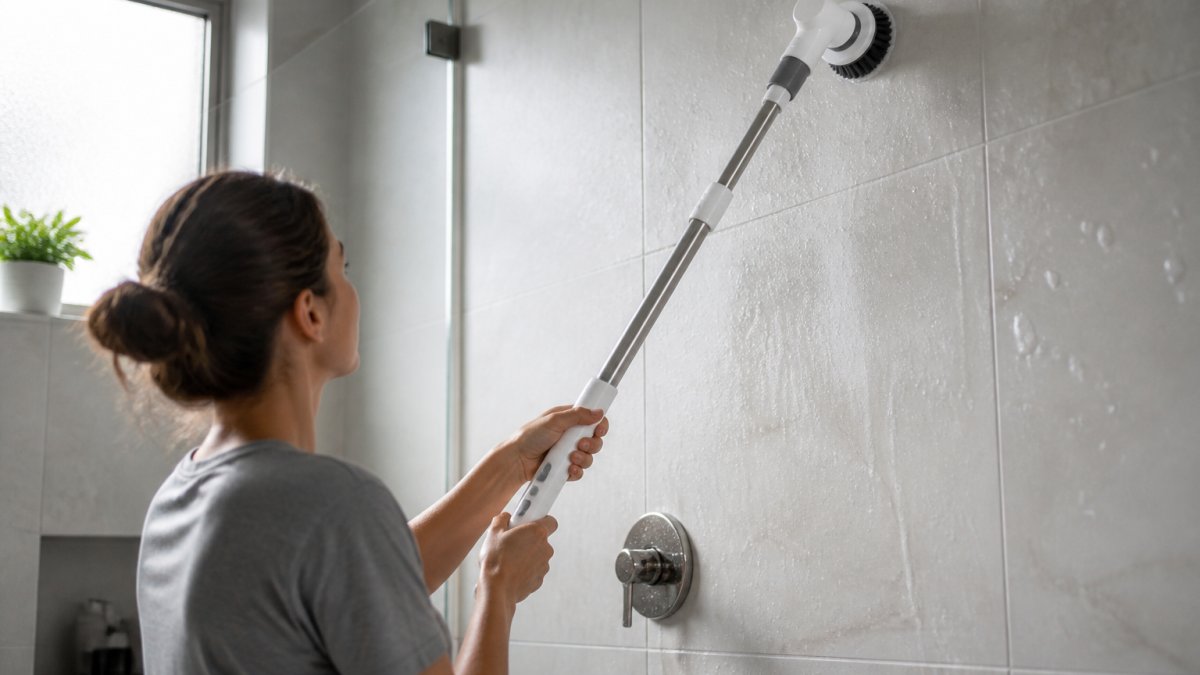
Nuksy's scrubber adjusts from roughly 12 to 54 inches. Shorten it for scrubbing the tub floor on your knees; extend it to reach the top of a tile wall standing up.
Standing to clean also changes the physics in your favor. You can apply steady downward pressure with your body weight instead of your wrist, which is where most manual scrubbing fatigue comes from.
Spin Scrubber Brush Heads: Which One for Which Surface
Spin scrubber brush heads are not interchangeable in practice, even when they fit the same mount. Bristle stiffness, head shape, and the speed you pair them with decide whether you lift soap scum off glass or grind a dull haze into an acrylic tub.
The table below maps heads to the surfaces and soils you actually meet in a shower, plus the speed setting that keeps the head from stalling or scratching.
| Brush Head Type | Best For | Speed Setting | Avoid On |
|---|---|---|---|
| Soft bristle, flat | Glass doors, acrylic tubs, enamel, coated fixtures | Low | Heavy grout buildup, unsealed stone |
| Medium bristle, flat | Glazed ceramic tile, large wall areas, fresh soap film | Low to medium | Unsealed natural stone, painted surfaces |
| Stiff bristle, narrow | Grout lines, tile seams, textured tile, hard-water edges | Low | Glass, acrylic, painted surfaces, factory coatings |
| Corner or detail head | Tracks, hinges, faucet bases, tight edges | Low | Large flat areas (slow and uneven) |
| Scouring pad head | Dried soap scum film on glazed tile | Low, light pressure only | Any glossy or coated finish |
Matching the Head to the Soil, Not Just the Surface
Soap scum and hard-water deposits behave differently under the same brush. Soap scum is a soft, oily film that lifts once it has been softened, so a medium bristle head at low speed with light pressure is usually enough.
A common pattern is to over-brush scale with a stiff head on glass and end up with fine scratches that trap even more mineral film.
Speed, Pressure, and Stalling
The lower speed setting is not just for delicate surfaces. It is also the setting that keeps a stiff narrow head turning when you press it into a grout line.
Nuksy's scrubber ships with eight interchangeable heads, which covers the range above without buying extras. Match the head and the speed to the surface and soil before you turn the tool on, not after.
Cordless Electric Spin Scrubber – 8 Brush Heads & Adjustable Handle →
How to Remove Soap Scum From Shower Tile
To remove soap scum from shower tile, soften the film first, then let the brush do the work at low speed with steady pressure.
Work in this order:
- Wet the wall with warm water and let it sit for a few minutes.
- Apply a cleaning solution suited to your tile and let it dwell.
- Fit a medium bristle head for tile, or a stiff narrow head for grout.
- Run the scrubber at the lower speed with light, even pressure.
- Rinse thoroughly and dry the wall to slow new buildup.
Hard-water stains are a different problem from soap scum. They are mineral deposits, and they respond to dwell time and repeated passes more than to brute force. Two or three short sessions beat one aggressive scrubbing that damages the glaze.
Safe Use on Delicate Finishes and Realistic Expectations
Delicate finishes include acrylic tubs, glass shower doors, painted surfaces, and any factory coating on a fixture. These surfaces scratch, and the scratch is permanent. The safe approach is the same every time: use the softest head that makes progress, keep the speed low, apply light pressure, and test on a small hidden area first, behind the toilet, under the tub lip, or in a corner the eye never lands on.
Which Finishes Need Extra Care
- Acrylic and fiberglass tubs and surrounds: soft bristle head only, low speed, no scouring pads. Acrylic dulls before it scratches, and the dull patch shows under bathroom lighting.
- Glass shower doors: soft or medium bristle head, low speed. Avoid stiff bristles and abrasive pads, which leave fine scratches that hold mineral film.
- Natural stone (marble, travertine, slate): unsealed stone should not be scrubbed with a power tool at all. Even sealed stone can etch, so test first and keep pressure light.
- Factory-coated fixtures (faucets, trim, shower heads): soft head, low speed, and never a scouring pad. Coatings wear through at edges and corners first.
- Painted surfaces and trim: soft head only, and keep the brush moving. A stationary spinning brush heats and dulls paint.
Realistic Expectations for Heavy Buildup
A power scrubber cuts effort and time, but it does not dissolve years of mineral scale in one pass. Plan on repeat sessions for heavy buildup and steady maintenance after that. Two or three short sessions with dwell time between them beat one aggressive scrubbing that damages the glaze. If the film has not softened, no brush speed will fix it, the chemistry has to do its part first.
Noise, Vibration, and Comfort Over a Full Bathroom
Cordless scrubbers hum rather than roar, but vibration travels into your hand over a long wall. A common pattern is grip fatigue in the wrist and forearm before the battery runs down. Take short breaks, keep your grip loose, and let the rotation do the work instead of bearing down. Balance matters too: a top-heavy tool with a fully extended handle is harder to control on a vertical surface than the same tool at half extension.
Long-Term Durability and Ownership
Long-term durability comes down to three parts: the motor, the battery, and the brush mount. Worn bristles, not a dead motor, are usually what ends a scrubber's useful run, so a replaceable brush head system extends the tool's life more than any single spec on the box. Battery capacity also fades with charge cycles, which is why a battery level display is more useful over time than a single runtime number.
U.S. Environmental Protection Agency guidance on safe cleaning product use
Mistakes to Avoid When Buying a Shower Spin Scrubber
The most common buying mistake is chasing the highest RPM number on the box. Speed is the easiest spec to print and the least useful on its own. Torque, battery runtime, and water resistance decide whether the tool survives a real bathroom.
Other traps to sidestep:
- Buying a fixed-length handle. You lose the reach that justified the purchase.
- Ignoring the brush mount. If replacement heads are hard to find, the tool is disposable.
- Skipping the water resistance rating. A wet environment punishes tools that are not rated for it.
- Assuming one head does everything. It does not, and the wrong head costs you a finish.
- Overextending on high surfaces. Use works against the joint, not for it.
Confirm the charging setup matches what you already own.
U.S. Consumer Product Safety Commission guidance on household product safety
Frequently Asked Questions
Are electric spin scrubbers worth it for shower cleaning?
They can be worth it if you deal with soap scum, hard-water stains, or grout lines that are hard to reach by hand. A cordless electric spin scrubber like the Nuksy model runs on a rechargeable battery, offers multiple speeds, and comes with interchangeable brush heads, so you can cover large tile areas faster than manual scrubbing. They work best as a supplement to regular cleaning, not a replacement for it.
What features should I look for in a shower spin scrubber?
Focus on battery runtime, water resistance, adjustable handle length, and brush head variety. The Nuksy Cordless Electric Spin Scrubber offers up to 90 minutes of runtime, an IPX7 water-resistance rating, a handle that extends from about 12 to 54 inches, and eight interchangeable brush heads. Two speed settings (220 RPM and 320 RPM) let you switch between gentle and heavier scrubbing.
Can an electric spin scrubber clean shower grout?
Yes, with the right brush head. A pointed or narrow brush head works best for grout lines because it fits into the grooves between tiles. Use a lower speed setting first to avoid splashing, then increase speed if needed. Pair the scrubber with a grout-safe cleaner and let it sit for a few minutes before scrubbing to loosen buildup.
How do you use an electric spin scrubber on soap scum?
Spray the tile with a shower cleaner and let it sit for a few minutes to soften the soap scum. Attach a flat or round brush head to your spin scrubber, start on the lower speed setting, and work in overlapping sections from top to bottom. Rinse the brush head periodically and finish with a clean water rinse to prevent residue from drying on the tile.
Cleaning a shower by hand means reaching, kneeling, and scrubbing until your wrist gives out. Nuksy stocks a cordless electric spin scrubber built to take that work off your hands, with eight interchangeable brush heads, two speeds at 220 and 320 RPM, an adjustable handle that runs from about 12 to 54 inches, and up to 90 minutes of runtime on a USB-C charge. It is IPX7 rated for the wet environment it works in. Browse the Nuksy cleaning lineup to find the setup that fits your bathroom.